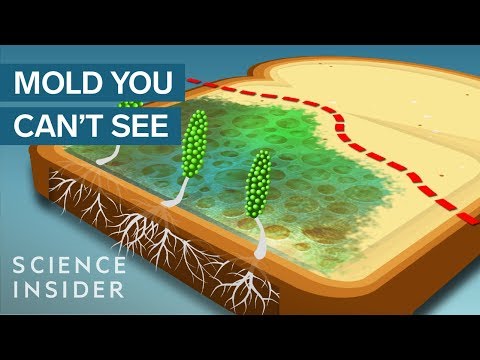
It’s not safe to eat bread or fruit infected with mold, even if you remove the moldy parts. When mold recreates, it spreads throughout your food, concealing in places you can’t see. And while many types of mold are safe, others can make you extremely sick. It’s just not worth the threat.
——————————————————
Science Expert informs you all you need to know about science: space, medication, biotech, physiology, and more.
Subscribe to our channel and visit us at: http://www.businessinsider.com/science
Science Insider on Facebook: https://www.facebook.com/BusinessInsiderScience/
Science Expert on Instagram: https://www.instagram.com/science_insider/
Organisation Insider on Twitter: https://twitter.com/businessinsider
Tech Expert on Twitter: https://twitter.com/techinsider
——————————————————.
Following is a records of the video:.
Storyteller: We’ve all existed. The loaf of bread you purchased a couple weeks earlier is beginning to grow mold and you’re questioning “Maybe I can simply cut the part where I can see the mold and consume the tidy part.” It ends up, despite the fact that you can not see it, your whole loaf of bread might be teaming with fungus. Following is a transcript of the video.
You’re all ready to make the sandwich of your dreams. Turkey, tomato, and swiss on a bed of romaine lettuce sandwiched in between two slices of sourdough. Classic.
Mold? The mold’s only on part of the bread.
There’s no such thing as a “tidy” part of moldy bread. That’s since mold is a fungi, like mushrooms.
So let’s rethink at that bread of yours. Ugh, disgusting!
Possibly you can simply get another piece from the very same loaf. Well, that’s not such a fantastic concept, either. Due to the fact that by the time mold grows its fuzzy head, what you’re truly seeing is the reproductive part of the mold called sporangiums. Each sporangium launches 10s of countless spores.
Even though you can’t see it, that whole loaf might be teeming with fungi.
However it looks like such a waste to just throw it out. After all, you consume mold on function all the time, like the mold that enters into making cheese, soy sauce, and even life-saving antibiotics, like penicillin. Eating a little bit on your bread can’t be that bad?
Eventually, it’s a gamble. Similar to eating a wild mushroom, lots of are fine. Some can be fatal.
Mold is the same method. There are thousands of various types of mold– much of which are safe to humans. Considering that so lots of types can grow up on food it’s nearly impossible to know if what you’re consuming is safe.
Cladosporium, for instance, can sometimes set off allergies however is typically harmless. Whereas other molds, like Penicillium crustosum, produce hazardous poisons called mycotoxins. A senior couple in 2005, for example, was admitted to the health center after consuming a can of soup contaminated with this sort of mold. They had extreme muscle tremors but eventually recuperated.
Other molds, like Rhizopus stolonifer, can have irreversible impacts. And you might recognize this mold given that it commonly grows on bread: blue-green, with black splotches, and incredibly fuzzy. In unusual cases, it can prompt a deadly infection called Zygomycosis, which triggers your blood to embolisms and can, ultimately, starve your cells of oxygen to the point that they die.
And it’s not like germs where a little heat will remove the danger because heats won’t break down the mycotoxins. And because you have no hint which one you’re about to put in your mouth, ask yourself: Is it really worth the threat?
https://xraytechniciancertification.org/never-eat-the-clean-part-of-moldy-bread/
No comments:
Post a Comment