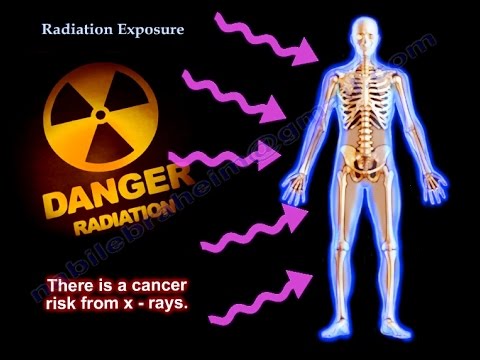
Dr. Ebraheim’s educational animated video demonstrates how radiation impacts the body, the various types of radiology treatments, and safety recommendations.
X-rays ionize human tissue and deposit energy that can cause harmful modifications within the body (break the DNA chain). There is a cancer risk from X-rays. The dosage of radiation is cumulative. X-rays are thought about for carcinogen list. The federal government is attempting to avoid making use of unneeded CT scans and x-rays to avoid unneeded direct exposure to radiation. This highlights the cancer threat. Medical professionals need to pay very close attention to the dangers involved with using x-rays. The cancer threat associated with radiation exposure is recorded in cases of atomic bomb survivors. The threat for medical usages is questionable and usually played down by doctors. Radiation at a high level is carcinogenic. The level of radiation from x-ray exposure is low. The effects of low-level radiation is not known.
What is the safe radiation level? The safe level is not understood. It is known that CT scans, fluoroscopy, mammography and x-rays expose the public to high levels of radiation especially in young females. The danger of exposure ought to balance the medical benefit. Enhance radiation dosages by exposing the patient only to enough radiation to get a clear image. There is a growing concern about the danger related to providing patient big doses of radiation. Using CT scans has actually increased recently in adults and kids possibly exposing the patient to an unnecessarily high dosage of radiation. CT scan is the technique often used to detect cancer, illness fractures and it exposes the client to a much bigger does of radiation than x-rays. Radiation from CT scan of the pelvis equals the very same amount as 100 chest x-rays. Kids are 10 times more sensitive to radiation than adults. 3-4 million children get CT scans and about 1,500 of them will establish cancer two decades later on. Children should not be offered an adult dose of radiation.
Radiation dose limitations:
The closer the extremity is to the radiation source, the higher the dose of radiation the client receives. When the distance from the beam increases, the dose of radiation is less. If the strength of radiation at 1 meter from the source is 100 mR/hr then the strength of radiation at 2 meters from the source is 1/4 or 25 mR/hr in same unit location.Systems of radiation (radiation nomenclature)
– Roentgen: unit of radiation exposure in air.
– Rad: energy taken in per gram of tissue.
– Rapid eye movement: biological result of a rad.
There is less exposure to the physician when imaging a smaller sized body part. Larger body parts develop an increased direct exposure to the doctor when imaging a patient with C-arm. Do not remain in the direct course of the radiation beam.
Protection:
– Tracking: a dosimeter badge only tapes just how much radiation you have actually received. It does not secure you from direct exposure to radiation.
– Protecting: lead dress and aprons work to stop exposure to fluoroscopy radiation. Lead aprons attenuate spread radiation by about 95%.
– Position
Quickly dividing cells are most sensitive to radiation exposure: sperms, lymphocytes, small intestinal tract, and stomach. Radiation damage rarely appears at the time of radiation. The very first results of radiation damage is normally seen as a drop in the white blood cell count.Early impacts or radiation direct exposure:
– Death
– Hematological anxiety
– Chromosome aberration
– Skin erythema
– Epilation.
Group exposure to radiation
– Direct beam 4,000 mrem/min
– Surgeon (1 ft.): 20 mrem/min entire body
– First assist (2 ft.): 6 mrem/min whole body
– No direct exposure (5 ft.) at scrub or anesthesiologist.
– 6 feet is safe.
End up being a good friend on facebook:
http://www.facebook.com/drebraheim
Follow me on twitter:
https://twitter.com/#!/ DrEbraheim_UTMC
Contribute to the University of Toledo Foundation Department of Orthopaedic Surgical Treatment Endowed Chair Fund:
https://www.utfoundation.org/foundation/home/Give_Online.aspx?sig=29

No comments:
Post a Comment