See www.radtechbootcamp.com today to see the whole X-Ray Circut video series and more!
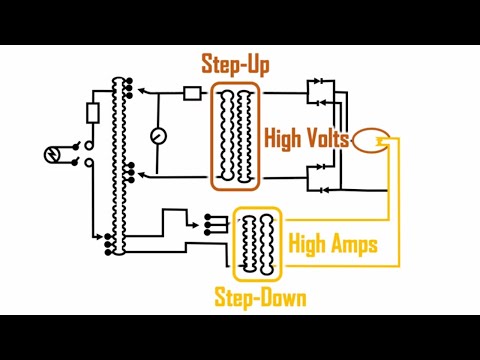
This video is about The X-Ray Circuit Transformers, an important element of an x-ray imaging system.
Transformers have a simple job … they change (or change) the voltage of an electrical circuit. The voltage can either be increased or decreased.
A step-up transformer INCREASES the voltage
A step-down REDUCES the voltage
Not made complex … however there is another variable affected when the voltage is changed.
A step-up transformer BOOSTS the voltage but DECREASES the amperage of the electrical energy
A step-down transformer DECREASES the voltage but BOOSTS the amperage of the electrical power
It’s kind of like this … the nozzle on a water hose can be gotten used to alter the pressure and circulation rate of the water.
When the nozzle is adapted to high pressure, the water comes out very quick, however there is less water coming out. This resembles a step-up transformer. The voltage (or pressure) increases, however the amperage (or flowrate) decreases.
When the nozzle is adjusted to low pressure, the water comes out really slow, but there is more water coming out. This is like a step-down transformer. The voltage (or pressure) goes down, but the amperage (or flowrate) goes up.
Various parts of the x-ray circuit require various volts and amps.
The x-ray tube requires a very high voltage to make x-rays, so that part of the x-ray circuit (primary circuit) uses a step-up transformer. A step-up transformer INCREASES the voltage however REDUCES the amperage of the electricity
The filament itself needs an extremely high amperage to develop a source of electrons, so that part of the x-ray circuit uses a step-down transformer. A step-down transformer DECREASES the voltage but INCREASES the amperage of the electrical energy.
A transformer is made of three parts:
A core
A primary coil, where the electricity enters into the transformer
A secondary coil, where the electricity heads out of the transformer.
Notice that a transformer has no moving parts. The modification in voltage happens due to the fact that of a procedure called “magnetic induction”.
Electricity streaming through the coil on the primary side produces an electromagnetic field.
That electromagnetic field engages with the coils on the secondary side and causes an electrical current to flow.
The number of turns on the main and secondary side identify whether the voltage is stepped up or stepped down.
In this example, the primary side has 5 turns and the secondary side has 10 turns.
There are two times as lots of turns on the secondary side, so the voltage will double. This is a step-up transformer because of the voltage boosts.
If we reverse the turns ratio the opposite occurs.
On this transformer, the primary side has 10 turns and the secondary side has 5.
There are half as numerous turns on the secondary side so the voltage reduces by half. This is a step-down transformer because the voltage reduces.
Often the turns ratio can be more complicated so we need the formula to use. Here’s one way of writing the formula:
V_S= V_P x (N_S/ N_P )
Where:
VS = Voltage on the main side
VP = Voltage on the secondary side
NS = Variety of turns on the secondary side
NP = Variety of turns on the secondary side

No comments:
Post a Comment